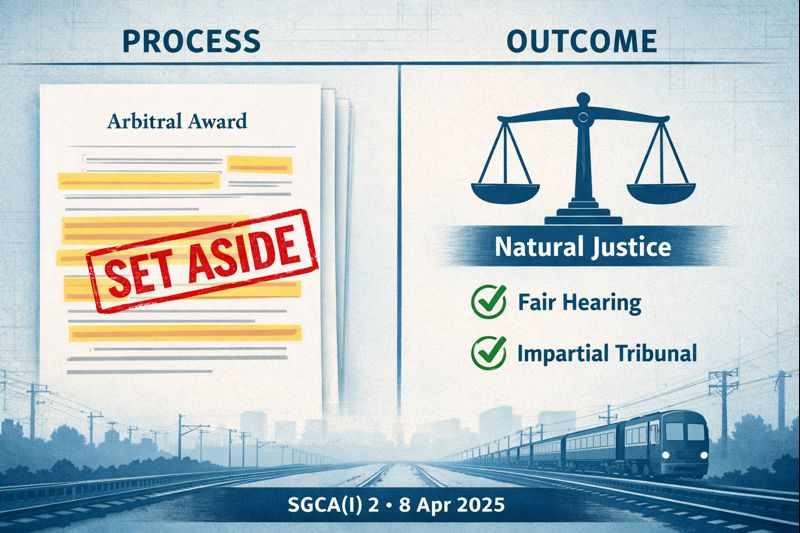
DFCCIL v IRCON, Mitsui & Tata Projects — [2025] SGCA(I) 2
This dispute comes from India’s Western Dedicated Freight Corridor. DFCCIL (Employer) engaged a consortium (IRCON + Mitsui + Tata Projects) under FIDIC Yellow Book 1999 for a major package (CPT-13).
In January 2017, India’s Ministry of Labour issued a notification sharply increasing minimum wages. The Contractor invoked FIDIC YB 1999 Sub-Clause 13.7 seeking additional payment for increased labour cost. DFCCIL disputed entitlement/impact.
The ICC tribunal allowed the change-in-law claim—but later scrutiny showed the award was not truly written from the ICC case record.
- Heavy copying: a large chunk of the ICC award was copied verbatim from a domestic award (CP-301).
- Unargued material: the award included authorities and contract content not cited/argued by the ICC parties.
- Seat confusion: parts of the award treated Indian law as if it were the lex arbitri for interest/costs, even though the ICC arbitration was seated in Singapore.
DFCCIL challenged the award using Model Law Art 34 and IAA s24(b) (natural justice / fair hearing).
| What triggered the set-aside | What tribunals should do instead |
|---|---|
|
Red flag
Importing conclusions from parallel cases (pre-judgment risk).
|
Safer practice
Ring-fence each record: show reasoning tied to the parties’ submissions in that arbitration.
|
|
Red flag
Relying on materials not put to parties → no chance to respond.
|
Safer practice
If you want to use external reasoning: disclose + invite submissions before relying on it.
|
|
Red flag
Errors carried over (wrong clause version / seat-law confusion).
|
Safer practice
Seat discipline: apply the correct lex arbitri for procedure, interest, costs, and remedies.
|
- 13.7 entitlement isn’t the headline. The award fell because the process looked like a “foregone conclusion.”
- Parallel arbitrations magnify bias risk. Same presiding arbitrator + same issue = higher duty to show independent analysis.
- Fair hearing is non-negotiable. If something influences the decision, parties must get a chance to address it.
How tribunals treat labour escalation overlaps + drafting tips
When courts will support (or refuse) DAB/DAAB outcomes
Protect entitlement with time-bars and correct notice posture
What happens when arbitration collides with insolvency regimes
1) Same arbitrator in multiple cases? Flag apparent bias risk early.
2) If tribunal cites something you never argued, request right to respond.
3) Keep the seat-law clear for procedure/interest/costs.
4) For change-in-law claims, document: Base Date, law change date, cost impact, and the claim timeline.
Court of Appeal Findings — [2025] SGCA(I) 2
The Court began from a simple (but powerful) idea: since arbitration generally offers no appeal on merits, the system survives only if parties can trust that the process is fair, impartial, and equal. That’s why courts will intervene when the integrity of the decision-making is undermined.
A) Prejudgment & apparent bias (anchoring / confirmation bias)
Using earlier awards as a starting template isn’t automatically wrong. But here, the scale and manner of reuse signalled a tribunal that looked closed-minded to differences in the ICC case (new arguments, different terms), producing outcomes that appeared predetermined “for consistency”.
B) Extraneous material + no fair hearing
The ICC award included reasoning and material originating from outside the ICC record (parallel proceedings), which the ICC parties did not submit or contemplate — and were not given a chance to answer. With arbitration confidentiality, parties cannot be expected to respond to an unseen “sister case” narrative.
C) Unequal treatment inside the tribunal (information asymmetry)
Only the presiding arbitrator carried personal knowledge from the parallel cases; the two co-arbitrators did not. Reliance on unseen parallel-case reasoning created an imbalance: the panel members did not share equal access to what was influencing the decision.
The Court agreed the breach was so fundamental that it permeated the entire award. That’s why it rejected requests to “salvage” parts of it or remit it for correction.
| Request / option | What the Court did |
|---|---|
| Appellants “Copying didn’t change the result” | Court Focus stayed on process integrity: a fair-minded observer could see an absence of fresh, independent evaluation. |
| Appellants Partial set-aside / remission | Court Rejected: the breach was systemic, leaving no clean segment to preserve. |
- Copying is not automatically fatal. The question is what it reveals about independent application of mind.
- Copying party submissions can be harmless if it reflects genuine agreement.
- Copying from a related award (different parties + confidential record) is a red flag because it can smuggle in unseen reasoning and evidence.
- Flag any shared arbitrator across related cases early (bias optics matter).
- If an award references points you didn’t argue, demand a right to respond before it is relied upon.
- Keep the seat-law clean (procedure/interest/costs follow lex arbitri, not the substantive law).
- In a 3-member tribunal, watch for information asymmetry (one member privately “knows” more than the rest).
How “double recovery” and escalation overlaps get analysed
What courts protect when dispute board processes are respected
Where procedural rules decide the outcome (not “who’s right”)
Build the full claims→decision→dispute pathway in one system
Implications for International Arbitration & Construction Contracts
A) Singapore is pro-arbitration — but not “pro-bad-process”
The judgment is basically a giant neon sign saying: efficiency and consistency can never beat fairness. Arbitrators must be impartial — and must also be seen to be impartial at every stage.
B) Risk allocation clauses only “work” when each claim is judged fresh
Yes, the underlying dispute was about FIDIC 13.7 (Change in Legislation) — and conceptually it mirrors NEC Compensation Events (external change triggers a time/money adjustment). But even with identical clause wording, different packages can have different Particular Conditions, records, and arguments. If an adjudicator doesn’t “reset” their mind, the award itself becomes vulnerable.
C) The lesson applies beyond “change in law” — think delays, variations, and force majeure
On megaprojects, one common event (late access, permits, utilities, wage hike, major delay cause) creates multiple claims across packages. This case warns: a tribunal can’t copy a delay/causation analysis from Package A into Package B without re-checking timing, causation chain, and contract specifics.
D) Set-aside at the seat = the award turns into “paper with no teeth”
Once annulled at the seat, the award becomes a legal nullity there — and enforcement elsewhere becomes far harder under the New York Convention framework. Translation: a procedurally tainted award can wipe out years of claim value.
E) Drafting + institution takeaway: manage parallel proceedings on purpose
If you expect parallel claims across packages, consider drafting for consolidation/joinder where feasible, or at least procedural guardrails on how information can move between cases. Institutions may also need stronger “pattern detection” during award scrutiny when the same arbitrator is on multiple sister disputes.
| Don’t (high risk) | Do (award-safe) |
|---|---|
| Don’t reuse reasoning from sister cases silently | Do decide only on the record + submissions in that case |
| Don’t import “helpful” authorities that parties never argued | Do disclose intent + invite comments before relying on anything external |
| Don’t chase consistency so hard that you ignore factual nuance | Do accept that related disputes can legitimately produce different outcomes |
| Don’t allow one tribunal member to hold unseen “extra knowledge” | Do ensure equal information across panel members (avoid asymmetry) |
Build a clean pipeline so claims don’t die — or explode later
What happens when the dispute board step collapses
Base Date mistakes quietly destroy entitlement
Enforcement posture: what parties do next, and why it matters