Contract inputs
Repayment mechanics
Multicurrency composition
Payment plan (for simulation)
Tranche descriptions (optional, for PCs)
Your tailored Particular Conditions (preview)
Repayment & APG step-down schedule (simulation)
Diagnostics
Purpose of Clause 14.2 (why this exists and how it protects both sides)
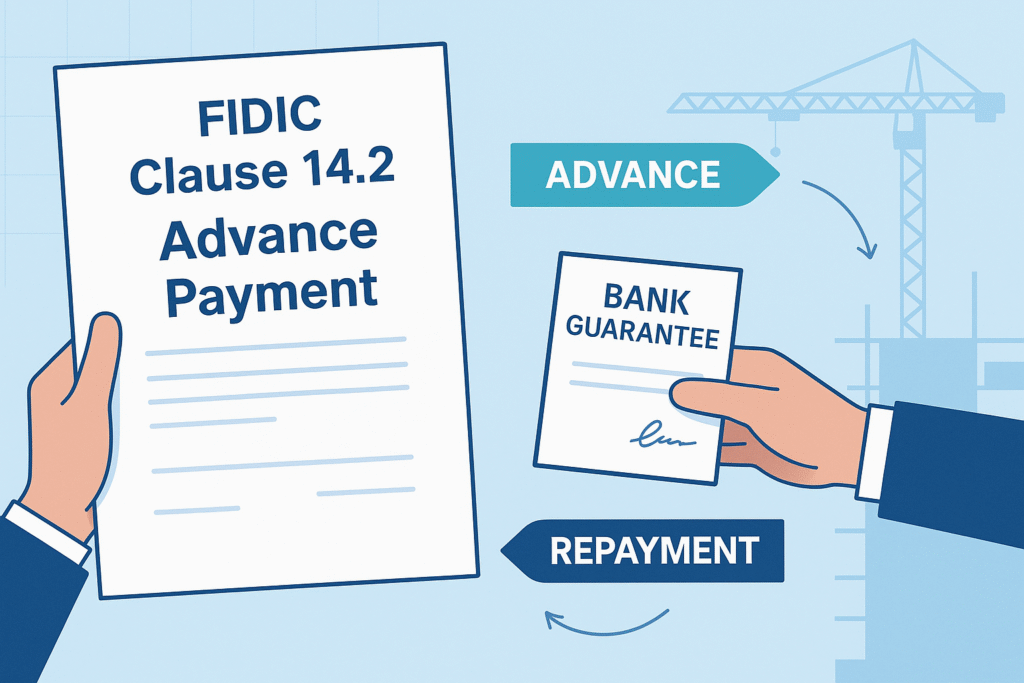
Think of Clause 14.2 as the contract’s early-cash jump-starter. It lets the Employer front an interest-free sum so the Contractor can mobilize people, plant, temporary works, and kick off design without loading the Contract Price with expensive financing costs. In the 2017 Yellow Book, the purpose is explicit: the Employer pays, as an interest-free loan for mobilization and design, after an Advance Payment Certificate is issued and subject to the Contract Data stating the amount and currencies.
Why is this a big deal?
Contractor wins (cash-flow): Early liquidity arrives before the first big IPCs roll in. That means quicker procurement, faster mobilization, and fewer “cash valleys.”
Employer wins (security): Payment only flows against an Advance Payment Guarantee (APG), on-demand and kept valid until fully repaid. If the Contractor doesn’t extend a dated APG and the advance is still outstanding, the 2017 Book lets the Employer call the guarantee for the unrepaid balance (there’s a crisp 7-day rule—more below).
A key “scope switch”: if no advance amount is stated (Contract Data in 2017, Appendix to Tender in 1999), Clause 14.2 simply does not apply. ✔️
- Procure long-lead items sooner; avoid “cash valleys.”
- Lower financing baked into the Contract Price.
- Confidence to ramp people/plant/temporary works.
- 7-day rule (2017): if the APG isn’t extended >7 days before expiry while any balance is outstanding, Employer can call for the unrepaid balance.
- APG remains valid until the advance is fully repaid through deductions.
- Engineer issues an Advance Payment Certificate before money flows.
Set a contract amount and your agreed advance % + repayment rules (illustrative). We’ll show how many IPCs it roughly takes to clear the advance.
- State the advance in Contract Data/Appendix (else 14.2 does not apply).
- Define start-threshold + amortization rate (when deductions begin, how fast they run).
- APG validity management — diarise renewal windows; align with programme slippage.
- APG lapses with balance outstanding → Employer can call (2017 7-day rule).
- Mismatch between currencies/proportions in APG and Contract Data.
- Repayment not synced with variations/downsizing → under- or over-recovery fights.
- 2017 YB 14.2 describes the advance as an “interest-free loan for mobilisation and design” (see scholarly summaries). Emerald Publishing – Contract Price & Payment
- APG renewal rule — entitlement to call if not extended >7 days before expiry (with balance outstanding). CMS: Guide to FIDIC 2017
- 14.2 inapplicable if no amount is stated (1999 Appendix to Tender; 2017 Contract Data). 1999 YB PDF (unofficial)
- Payment speed: 35 days (2017) vs 42 days (1999) once prerequisites are in place. International Construction Knowledge Hub
📘 Yellow Book 1999 — Clause 14.2 (Advance Payment)
Trigger & nature: An advance is paid as an interest-free loan for mobilization/design when the Contractor has submitted an APG in the required form; amounts and currencies are set in the Appendix to Tender. (If the Appendix is silent, 14.2 doesn’t apply.)
Keep the APG alive: The APG must remain valid and enforceable until full repayment, but its face value may step down as repayments appear in Payment Certificates. If the guarantee has an expiry date and the advance isn’t fully repaid 28 days before expiry, the Contractor must extend it.
Repayment rules (defaults):
- Start repayment when total certified interim payments exceed 10% of the Accepted Contract Amount (less PS).
- Repay at 25% of the amount of each Payment Certificate (excluding advance/retention effects), in the same currencies and proportions as the advance, until it’s zero.
- If not fully repaid by Taking-Over or termination (Clauses 15, 16, 19), the entire outstanding balance becomes immediately due to the Employer.
Where it appears in the Statement: The monthly Statement must show “amounts to be added/deducted for the advance payment and repayments” per 14.2.
📒 Yellow Book 2017 — Clause 14.2 split for clarity
14.2 (chapeau)
Applies only if an amount is stated in the Contract Data. The Employer pays the advance, as an interest-free loan, after the Advance Payment Certificate is issued.
14.2.1 — Advance Payment Guarantee (APG)
Contractor must provide an APG equal to the advance (amounts/currencies), from an entity/country the Employer consents to, on an agreed form.
APG must remain valid until full repayment; its amount may reduce progressively to match repayments.
If the APG has an expiry date and the advance is not fully repaid 28 days before expiry:
- Contractor extends the APG,
- immediately submits evidence, and
- if the Employer doesn’t receive that evidence 7 days before expiry, the Employer may claim the unrepaid amount under the APG.
14.2.2 — Advance Payment Certificate
The Engineer must issue the Advance Payment Certificate within 14 days after:
(a) Employer has received both the Performance Security and the APG (each in the proper form/from an acceptable entity), and
(b) Engineer has the Contractor’s application (in a Statement) for the advance.
14.2.3 — Repayment of Advance
Same default mechanics as 1999, expressed by currency:
- Start when total certified interim payments in the same currency exceed 10% of that currency’s portion of the Accepted Contract Amount (less PS).
- Deduct 25% of each IPC (excluding advance/retention moves), in the currencies and proportions of the advance, until fully repaid.
Payment clocks around the advance (2017 ecosystem):
Employer must pay the amount certified in an Advance Payment Certificate within the Contract Data period (default 21 days) after receiving that certificate.
Independently, no amount (generally) is certified or paid until the Performance Security is in place and the Contractor’s Representative is appointed (a 14.6 gateway). That harmonizes neatly with 14.2.2, which already requires the PS + APG before the advance can be certified.
Cross-referencing that really matters — how Clause 14.2 plugs into the rest (deep, friendly, and super practical)
Let’s treat Clause 14.2 like the hub of a wheel. The spokes? Performance Security, Statements, IPC rules, payment clocks, currencies, and the “oh-no” moments at Taking-Over or termination. Here’s how they snap together, with exact clause hooks so you can navigate the contract like a pro. 🧭
A) The starter keys: 4.2 Performance Security → 14.2.2 Advance Payment Certificate
Think of this as the ignition sequence. In the 📒 2017 Book, the Engineer cannot issue the Advance Payment Certificate until two things land in the Employer’s hands (and in the correct form/from an approved entity): the Performance Security and the Advance Payment Guarantee (APG). Only then does the Engineer have 14 days to issue that certificate. That’s your green light for the Employer to pay the advance.
Zoom out to 4.2 itself (2017): it sets the timing (e.g., deliver PS within 28 days of the Letter of Acceptance), the consent-to-issuer rule, and the “keep it valid until Performance Certificate” requirement. All of that underpins the 14.2 gateway.
In 📘 1999, the choreography is similar but the form is different: the first instalment of the advance appears in an IPC once the Employer has received the Performance Security and the APG—so your “advance” lived inside the first IPC, not a bespoke certificate.
Conversational takeaway: No PS/APG, no certificate, no cash. That’s by design—it forces early risk controls before front-loading money.
B) The spine of the whole payment story: 14.3 Statements (make them do the heavy lifting)
Your monthly Statement is where the advance request and the ongoing repayments live. Both editions make this explicit.
📘 1999: the Statement must include “amounts to be added and deducted for the advance payment and repayments” under 14.2.
📒 2017: same idea, spelled out in the 14.3 itemized list: include the advance payment and repayments line, in the currencies of the Contract, in sequence.
And timing? 2017 says submit after the end of the period of payment stated in the Contract Data (if not stated, after each month). 📘 1999 has a parallel monthly cadence.
Quick gut check: if your Statement doesn’t show the advance/repayment line items cleanly, audits and cash control get messy fast.
C) The payment clocks: 14.7 Payment + 14.8 Delayed Payment (who pays when—and what if they don’t?)
Once the Advance Payment Certificate issues (2017), 14.7 kicks in: the Employer must pay the amount certified within the period stated in the Contract Data (default 21 days) after receiving that certificate. If they miss it, 14.8 adds financing charges—compounded monthly—on the unpaid amount for the period of delay.
1999 is similar in spirit, but with different markers: the Employer pays the first advance instalment within 42 days after the LOA or within 21 days after receiving the PS and APG (whichever is later). Delays trigger financing charges under 14.8.
Human translation: 2017 = “pay in 21 days by default after the Advance Payment Certificate.” 1999 = “42 days from LOA or 21 days from PS+APG—whichever is later.” Either way, late money costs money.
D) The “no PS, no IPC” gate: 14.6 Issue of IPC (and why it still matters to 14.2)
Even apart from the advance, 14.6 is a universal gate: no amount is certified or paid until the Performance Security is in place.
📒 2017 explicitly says: no certification or payment until the PS is received, and even adds a governance nudge (you must have appointed the Contractor’s Representative).
📘 1999 is briefer but clear: no certification or payment until the PS is approved.
Tie-back to 14.2: if the PS (or APG) is missing, you can’t get the Advance Payment Certificate (2017) or the first IPC with the advance (1999). Full stop.
Small but mighty point: in 2017, the Engineer even has structured rules for withholding amounts in IPCs (14.6.2)—but can’t withhold for random reasons. That discipline helps avoid “creative” delays to cash flow.
E) Currencies & proportions: 14.2 ↔ 14.15 (and the data tables that drive reality)
Your advance and its repayments must mirror currencies and proportions—both books hammer this. So if you receive 60% Local / 40% Foreign, your repayment deductions follow that exact split in each IPC. 📒 2017 states this directly within 14.2.3; 📘 1999 says the same within 14.2.
Where do you set the knobs?
📒 2017 Contract Data has slots for “Currency or currencies of Advance Payment,” “period for payment of Advance Payment,” and the payment periods for interim/final payments—this is where you tailor the engine room.
📘 1999 Appendix to Tender captures the total advance, number/timing of instalments, currencies, plus the two famous levers: when to start repayment and the amortization %. (This is why you’ll see tender tables with “start at __% of Accepted Contract Amount” and “deduct __% each IPC.”)
Pro-tip: finance teams should map these data fields into the ERP from day one. Wrong currency split → wrong amortization → reconciliation pain.
F) The “event edges”: Taking-Over and termination (the instant-due rule)
Both editions say the quiet part out loud: if the advance isn’t fully repaid by Taking-Over or by termination, the entire outstanding balance becomes immediately due to the Employer.
📒 2017 lists 10.1 Taking-Over and termination under 15/16/18 as the triggers.
📘 1999 lists 10.1 and termination under 15/16/19.
This also echoes forward in the termination and suspension clauses: e.g., 2017’s 16.1 lets the Contractor suspend if 14.7 payments aren’t made—so the 14.2 money pipeline is not isolated; it’s part of a broader “pay-on-time or face consequences” ecosystem.
Plain English: plan to hit zero balance before TOC. Otherwise, you’ll face an immediate set-off or cash call just when you’re trying to demobilize.
G) The forms you’ll actually use: Annex E – Advance Payment Guarantee (2017)
2017 ships with a sample APG text in the Forms of Securities. Using it (or mirroring it closely) reduces negotiation friction and ensures on-demand language is fit-for-purpose.
Nice side effect: pairing Annex E with 4.2’s issuer-consent rule tightens bank quality while keeping the Contractor’s ultimate responsibility intact.
H) Bonus wiring: 14.4 Schedule of Payments and 14.6/14.7 mechanics
If your contract uses a Schedule of Payments, 14.4 tells you how those installments interact with 14.3’s “estimated contract value” line. It doesn’t replace the advance mechanics—repayments still follow 10%/25% defaults unless the Contract Data says otherwise— but it does shape when you hit the 10% trigger.
Translation: a front-loaded Schedule of Payments might push you over the 10% line earlier—so your 25% deductions start biting sooner. Make sure that’s what you intended.
Clause 14.2 — Video explainers
1999: Contractor must extend if still outstanding 28 days before expiry.
2017: Contractor must extend and send proof; if the Employer doesn’t get that proof 7 days before the expiry, the Employer can call the unrepaid sum under the APG.
Takeaway: Track APG dates like safety-critical items. Put diary alerts at T-42, T-28, T-10, T-7.
Think of Clause 14.2 as a small, well-tuned engine. Your Particular Conditions are the ECU map that makes it purr under your project’s load. Below are “drop-in” options—each with (i) what to add, (ii) why it helps, and (iii) example wording you can adapt. I also flag interactions with 4.2, 14.3, 14.6–14.8, 15/16/18 (2017) or 15/16/19 (1999) so nothing fights the base text.
Nail the “data knobs” (amount, tranches, timing, currencies)
Why: If the Contract Data (📒2017) or Appendix to Tender (📘1999) is vague, the Engineer is left to improvise—and finance teams suffer.
Add this clarity
- Total advance % and currencies (mirror the Contract Price breakdown).
- Number of tranches and preconditions for each tranche.
- When repayment starts (the “10%” trigger by default) and how fast (the “25% per IPC” default).
- A latest date to submit the APG (e.g., within 14 days of LoA).
- The period for payment of the Advance Payment Certificate (if not the default 21 days).
“Advance Payment: 15% of the Accepted Contract Amount, in the currencies and proportions of the Contract. Two equal tranches: Tranche-1 upon issue of the Advance Payment Certificate; Tranche-2 upon submission of (i) mobilization plan and (ii) evidence of site establishment. Repayment commences once cumulative certified interim payments exceed 10% of the Accepted Contract Amount (less PS) and continues at 25% of each Interim Payment Certificate until repaid in full, in the same currencies and proportions as the advance.”
When to tweak: If your advance is > 22%, the default 10%/25% won’t always zero out before TOC—raise the deduction rate or trigger earlier.
Make the APG “failsafe” (face value, step-downs, expiry, issuer quality)
Why: The Advance Payment Guarantee (APG) protects the Employer’s early cash; the Contractor needs predictability. Put both in writing.
Add this clarity
- Form: “on-demand” wording aligned with the sample form (2017’s forms pack).
- Issuer quality: bank rating or locally licensed bank + counter-guarantee; consent doesn’t relieve the Contractor.
- Progressive reduction: step the APG down in line with repayments (no arguments later).
- Expiry handling: diary rules and an explicit 7-day call right if extension evidence isn’t received in time.
- Replacement if the issuer is downgraded or sanctioned.
“The Advance Payment Guarantee shall be on-demand, substantially in the form included in the Contract, issued by a bank acceptable to the Employer (minimum long-term rating A- or a locally licensed bank backed by a counter-guarantee acceptable to the Employer). The APG amount shall be progressively reduced after each Interim Payment Certificate to equal the then-outstanding unpaid balance of the advance. If the APG has an expiry date and any part of the advance remains unpaid 28 days before expiry, the Contractor shall extend the APG and submit evidence of extension. If the Employer has not received such evidence 7 days before expiry, the Employer may call the APG for the unpaid balance. If the issuer is downgraded below A-, the Contractor shall within 21 days replace the APG with one from an acceptable issuer.”
Tip: Keep the governing law and place for demand on the guarantee simple and enforceable in the project’s jurisdiction.
Tie the certificate to clean prerequisites (no PS/APG → no cash)
Why: 14.2.2 (📒2017) already sequences this, but make the “inputs” black-and-white so the Engineer isn’t forced to “half-certify”.
Add this clarity
- Advance Payment Certificate only after the Employer has the Performance Security (per 4.2) and the APG, and the Engineer has the Contractor’s Statement item requesting the advance.
- If Tranche-2/3 are used, list the documentary milestones (e.g., plant on hire, designer mobilized, insurances in place).
“The Engineer shall not issue an Advance Payment Certificate until the Employer has received the Performance Security and the Advance Payment Guarantee, and the Engineer has received the Contractor’s Statement including the advance request line item with supporting documents. For Tranche-2, the Contractor shall also submit: (a) mobilization plan approval notice, (b) evidence of site establishment, and (c) insurances under Clause 19 in effect.”
(Keeps 14.6’s “no PS, no certification” principle intact and audit-friendly.)
Keep the money honest (use-of-funds, audit trail, misapplication remedy)
Why: Employers fear the advance being spent on unrelated overhead; Contractors want certainty that legitimate mobilization/design drawdowns won’t be questioned.
Add this clarity
- Use-of-funds statement: earmark for mobilization, temporary works, early design procurement (list examples).
- Audit shelf: simple ledger + copies of high-value invoices/POs.
- Cure: if misapplied, allow the Employer to accelerate repayment deductions or set off the misapplied portion.
“The advance shall be applied exclusively to mobilization and design/start-up costs, including (without limitation): temporary facilities, key personnel mobilization, long-lead design software/licenses, and initial plant/equipment on-hire. The Contractor shall maintain a ledger of advance disbursements and retain copies of invoices/POs > [threshold]. On notice of misapplication, the Employer may instruct the Engineer to increase the repayment deduction rate up to 35% of each IPC until the misapplied amount is neutralized.”
Smooth the multi-currency math (mirror in, mirror out)
Why: The books require repayment in the same currencies and proportions as the advance. Spell it out to avoid spreadsheet wars.
Add this clarity
- Fix the currency proportions in the Contract Data/Appendix and echo them in the IPC template.
- State the rounding convention and how to handle currency shortfalls if one currency lags.
“Repayment shall be deducted in each currency pro rata to the currency composition of the advance, using the same exchange rules as the Contract Price. Rounding shall be to the smallest payable unit in each currency. Any currency-specific shortfall is carried forward in that currency to the next IPC.”
Give the Engineer a clean “withhold & correct” toolkit (but no surprises)
Why: You want disputes to be about facts, not format. Equip the Engineer to keep paperwork crisp—without inventing new hurdles.
Add this clarity
- If the advance line is missing from the 14.3 Statement, Engineer returns for correction (with a short resubmission window).
- If the APG value is out of sync with the outstanding balance, Engineer can withhold the mismatched portion.
“If the Statement omits the advance/repayment line item or if the APG face value exceeds the outstanding advance by more than 10%, the Engineer may withhold certification of the advance-related items and return the Statement for correction. The Contractor shall resubmit within 5 days.”
Avoid a TOC cash shock (pre-TOC zeroing & set-off)
Why: Both editions make any unpaid advance immediately due at Taking-Over or termination. Pre-wire the behavior so it’s painless.
Add this clarity
- Require a “pre-TOC position” note in the penultimate IPC stating the residual advance and the plan to zero it.
- Confirm the Employer’s right of set-off across certified sums and securities.
“With the Statement preceding the Taking-Over Certificate, the Contractor shall include a schedule showing the anticipated residual advance and the deductions required to reduce it to zero. Any residual balance at Taking-Over or termination shall be immediately due and may be set off against sums otherwise payable to the Contractor or called from the APG.”
Contingencies & edge cases (bank downgrade, sanctions, assignment)
Why: Reality intrudes—banks get downgraded, sanctions land, lenders ask for assignments.
Add this clarity
- Downgrade/sanctions: require replacement APG within a short window.
- Assignment: permit assignment of the APG to the Employer’s lender (if any), without weakening the on-demand nature.
“If the APG issuer becomes subject to sanctions affecting payment, or is downgraded below the specified rating, the Contractor shall procure a replacement APG within 21 days. The Employer may assign the APG to its financing institution(s) without affecting its on-demand nature.”
Optional: smarter amortization profiles (front-loaded vs taper)
Why: One size rarely fits all. If your Schedule of Payments is front-loaded, you might prefer an early heavier pay-back; if cash is tight near commissioning, consider a taper.
Patterns you can use
- Front-loaded: Start at 30% per IPC until the outstanding falls below 5% of ACA, then 15%.
- Tapered: 20% until TOC-6 months, then 30% to zero before TOC.
- Milestone-triggered: Increase the deduction rate after specific milestones (e.g., end of structural works).
“Repayment deductions shall be 20% of each IPC until the earlier of (a) cumulative certified value reaching 60% of the Accepted Contract Amount or (b) 6 months before the anticipated Taking-Over Date; thereafter deductions shall be 30% of each IPC until the advance is repaid in full.”
(Always keep the calculation transparent and visible in the 14.3 Statement.)
Model clauses you can paste (edit the brackets)
Advance Payment: [__]% of Accepted Contract Amount, in [list currencies & proportions], payable in [__] tranches.
Period for payment of Advance Payment Certificate: [__] days (if not 21 days).
Repayment trigger & rate: Begin when cumulative certified totals exceed [__]% of Accepted Contract Amount (less PS); deduct [__]% of each IPC thereafter, by currency.
Form & issuer: On-demand form; issuer acceptable to Employer (rating [A-] or local bank with acceptable counter-guarantee).
Validity: Keep valid until the advance is fully repaid; progressive reduction after each IPC to equal the unpaid balance.
Expiry control: Extend ≥28 days before expiry if any balance remains; if evidence not received ≥7 days before expiry, Employer may call the unpaid balance.
Downgrade: Replace within 21 days if issuer rating falls below [A-] or on sanctions event.
Use: Mobilization, temporary works, design set-up, long-lead design software/licenses, initial plant on hire.
Audit: Maintain a ledger; retain invoices/POs > [value] for inspection upon [__] days’ notice.
Cure: If misapplied, Employer may increase deductions up to [__]% until cured.
Residual balance at Taking-Over or termination is immediately due and may be set off or recovered under the APG.
Micro-checklist (so you don’t miss a domino) ✅
Tiny “what-could-go-wrong” map (and the fix)
- APG lapses → Employer calls unrepaid balance.
Fix: Calendar alerts at T-42/T-28/T-10/T-7; write the 7-day call right plainly. - Advance too large → Not fully repaid pre-TOC.
Fix: Earlier trigger or higher deduction (e.g., 30% → 15% taper). - Currency mismatch → One currency lags; reconciliation pain.
Fix: Pro-rata deduction per currency, rounding rules, carry-forward in that currency. - Issuer downgrade → APG risk.
Fix: Replacement within 21 days clause.
Click Copy, paste into your email client, and replace the [[placeholders]]. Use the filter box to search by clause or keyword.