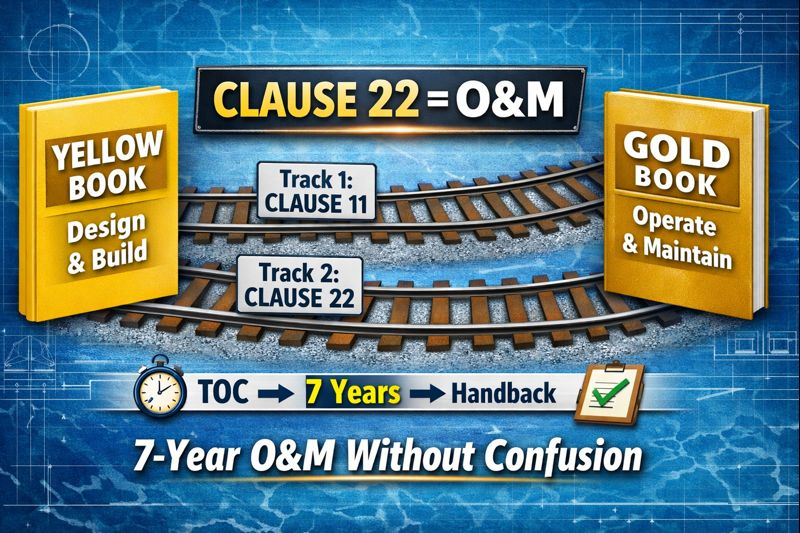
O&M in FIDIC Yellow Book: How PCC Makes It Work
Ever had a client say this with a straight face?
“We want an EPC contract… but also make the same contractor run the facility for 7 years.”
Sounds simple. Until you open the standard FIDIC Yellow Book (EPC/Turnkey) and realize it’s built mainly for design + build + testing + defects—not long-term operations.
To include long-term O&M in a FIDIC Yellow Book contract, add a dedicated O&M “service layer” in the Particular Conditions (PCC)—typically a new Clause 22—supported by clear definitions, a monthly payment certification process (e.g., a new Sub-Clause 14.17), KPI deductions, and a handback / certification mechanism—while keeping defects under Clause 11.
A quick intro: the kind of project we’re talking about
This post is based on a prominent public infrastructure project in Gujarat—the kind that must operate safely, consistently, and at event-level performance standards.
Think MEP-heavy, high-footfall, and high public-safety exposure (water systems, HVAC, electrical, BMS, fire & life safety, and strict statutory compliance). In projects like these, O&M is not a “nice-to-have”—it’s what keeps the asset alive.
- Include multi-year O&M inside the contract, not just in a technical narrative.
- Make it measurable, payable, and enforceable (every month, not only at handover).
- Evaluate O&M upfront—bidders submit an O&M Strategy at bid stage.
Visual map: requirement → where we placed it in the contract
This is the “client-friendly proof” that O&M is not just an ER sentence — it’s a complete, workable contract mechanism.
| What the client wanted | Where we made it contractual | Why it matters |
|---|---|---|
| O&M is part of the Contract | PCC Clause 22 (New O&M Service clause) | Service needs its own governance, not loose ER wording. |
| O&M starts cleanly | Definitions: Service Commencement Date = Taking-Over date | Eliminates “responsibility gaps” after handover. |
| O&M is measurable | KPI Schedule + deductions (Clause 22 + payment clause) | Makes performance enforceable, not subjective. |
| Monthly payment is controlled | Sub-Clause 14.17 (Monthly statement + certificate) | Prevents monthly payment disputes. |
| Defects don’t get mixed into fee | 14.17(d) (Service fee ≠ defect cost) | Stops “O&M fee includes defects” arguments. |
| O&M is planned, not improvised | Sub-Clause 8.3 (Programme additions) | Ensures staffing/mobilization and handback planning. |
| Handover includes useful data | ER deliverables (LOD 500/as-builts, manuals, training, asset info) | You can’t maintain what you can’t understand. |
Step-by-step: how we made O&M ‘work’ inside Yellow Book
These are the exact moves that convert a vague instruction (“provide O&M for 7 years”) into something the Engineer can administer without weekly arguments.
First, we built a mini “O&M dictionary” in the PCC definitions:
- O&M Service (what the contractor must do)
- O&M Management Requirements (the controlling service standard)
- O&M Period (start/end)
- Service Fee (what’s paid for service)
- KPI Schedule (what gets measured)
- Handback Requirements (what “good condition” means at the end)
In this Gujarat project, the commercial intent was:
That’s fine — but only if the contract says clearly:
- O&M is a service obligation (Clause 22)
- Defects remain under Clause 11 (defect remedies + notices)
- Service payments are not defect payments (14.17 / 14.17(d))
A public infrastructure facility in Gujarat isn’t maintained by good vibes. So Clause 22 scope covers typical operational realities, like:
- Planned maintenance (preventive + scheduled)
- Breakdown response (time-bound service actions)
- Statutory compliance (licenses, checks, records)
- Operation & maintenance of key plant (MEP backbone)
- Logs, trend data & performance reporting (evidence-driven service)
This is where O&M becomes real. We created a monthly cycle (new 14.17):
- Contractor submits Monthly O&M Statement by the 7th day, with logs + KPI evidence
- Engineer issues an O&M Payment Certificate within 21 days
- Certified amount = Service Fee − KPI deductions (± permitted adjustments)
Because service starts at Taking-Over, we pushed O&M into programme requirements (e.g., 8.3 additions):
- Service commencement milestone (TO date as a hard gate)
- O&M mobilization & staffing (not “to be arranged later”)
- Handback preparation milestones (so the end isn’t a mess)
ER deliverables are the “tools” the O&M team needs:
- LOD 500 as-builts + coordinated asset layouts
- Asset data (tags, capacities, makes, serials, test results)
- O&M manuals + SOPs
- Training records + competency sign-offs
- Warranty documents + spares lists/registers
Mini calculator: “What do we actually pay this month?”
Use this to demonstrate the logic to a client: base monthly fee → KPI score → deductions → payable fee.
Mini checklist: if you draft O&M in Yellow Book, don’t miss these
Tick items as you read. Your ticks are saved in the browser.
Common PCC drafting mistakes (and the fix)
-
Mistake: “O&M for 7 years” written only in Employer’s Requirements.
Fix: Put the administration mechanics in PCC (Clause 22 + payment cert + KPIs). -
Mistake: Mixing defects rectification and service deductions in one bucket.
Fix: Keep defects under Clause 11; use KPIs for service performance and 14.17 for service certification. -
Mistake: No clean “end” to O&M (no handback tests, no certification).
Fix: Define handback requirements + end-of-service tests + service completion certificate. -
Mistake: Payment clause doesn’t match KPI matrix (the deductions are “manual”).
Fix: Build a deterministic deduction formula (so certification is objective, not emotional).
Quick PCC “skeleton” you can show a client
Not full clause text—just the headings that prove the contract is “operable”.
| PCC insertion | What it controls (in real life) |
|---|---|
| Definitions (Service Completion Date, O&M Period, KPI, Service Report) | Stops “interpretation fights” before they start. |
| New Clause 22 Operation & Maintenance Service | Scope, staffing, statutory compliance, reporting, spares, training, step-in, handback. |
| New Sub-Clause 14.17 Monthly O&M Payment Certificate | Monthly fee + KPI deductions + supporting docs + certification timeline. |
| Programme additions (8.3) for service readiness | Mobilization, staffing, service milestones, handback preparation. |
| Clause 11 stays pure (Defects after Taking-Over) | Defects are remedied as defects; service performance is measured as service. |
Related reads on WisdomWavesHub.in (MEP-heavy O&M context)
These help readers connect contract O&M duties to real systems (HVAC, electrical, fire safety).
Watch (optional): 7-Year O&M “Gold Book logic” in Yellow Book PCC
These align perfectly with this page: definitions → defects vs service separation → KPI-linked monthly certification → handback.
🏗️ Build a world-class facility… then operate & maintain it for 7 years — without contractual time-bombs.
- 📘 Definitions (shared dictionary)
- 🧱 Separate Defects vs O&M
- 💰 KPI-linked monthly cycle: data → certification → fee minus deductions 🎯
⏱️ Two clocks start on the same day ⏳⏳, monthly loop 🔁, end with formal handback 🤝
Yellow Book में Gold Book-style O&M कैसे “डाला” गया — smart Hybrid: Clause 22.
- ✅ Hidden time-bombs: start date, defects vs maintenance boundary, roles, handback criteria
- ✅ Two-Track System: Clause 11 = Defects, Clause 22 = Service (O&M)
- 💰 Performance-linked payment + monthly reporting + end inspection/testing