Site icon Navigating Knowledge Across Domains

Sliding Scale Arrangements in FIDIC Construction Contracts Explained

Sliding scale arrangements in FIDIC construction contracts explained (price adjustment)

Last updated: 19 Dec 2025

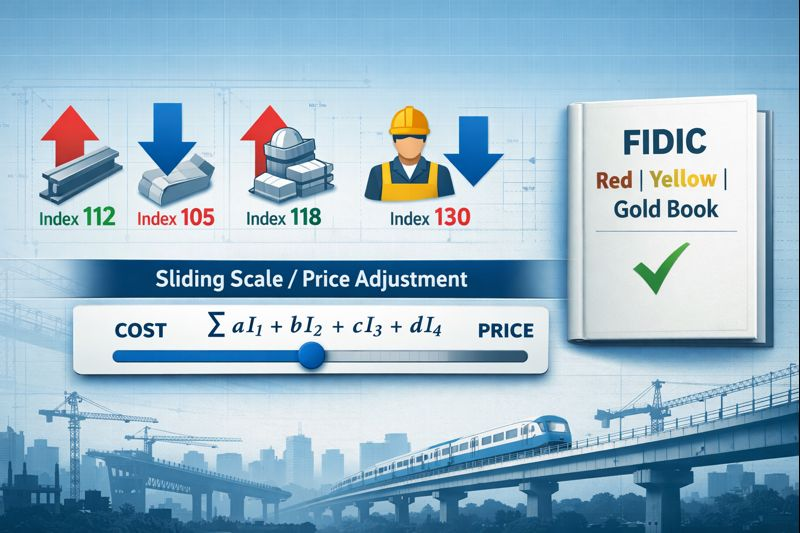
Featured snippet (quick answer): A sliding scale arrangement (also called a price adjustment / escalation mechanism) is a contract pricing method where amounts payable are adjusted up or down using agreed indices and weightings (labour, steel, cement, fuel, etc.) to reflect inflation/deflation during execution—most commonly implemented in FIDIC via Sub-Clause 13.8 (1999) or Sub-Clause 13.7 (2017), provided the contract includes the required adjustment schedules/tables.

1) What “sliding scale arrangement” means in construction contracts

In engineering terms, a sliding scale arrangement is a risk-sharing model for cost volatility:

Why it exists

Construction is a long-duration production process with exposure to:

A sliding scale doesn’t eliminate these risks—it allocates them transparently and reduces disputes about “who carries inflation.”2) Sliding scale in FIDIC: where it sits (and when it applies)

FIDIC 1999 (Red Book / Yellow Book concept)

FIDIC 2017 (Red Book / Yellow Book concept)

Related—but different—FIDIC mechanisms you must not confuse with sliding scale

Practical takeaway: A proper sliding scale arrangement in FIDIC is “formula + indices + coefficients + base date + payment timing.” Without those schedules, you’re usually left with only (a) variations, (b) change in law, or (c) exceptional events arguments—each with a higher disputes risk.

3) Types of sliding scale arrangements (from simplest to most robust)

Type A — Full indexation (multi-factor formula)

Best for long-duration civil works with volatile inputs.

Type B — Partial indexation (selected inputs only)

Common when Employer wants limited exposure:

Type C — Threshold / banded sliding scale

Adjustments apply only when inflation exceeds a band:

Type D — Cap-and-collar (ceiling and floor)

Type E — Two-way sliding scale (symmetrical)

Adjusts up and down (inflation/deflation). This is cleaner contract economics, but Contractors sometimes resist downward movement unless volumes are stable.

Type F — Hybrid: indexation + “open-book” for nominated imports

actuals (with audit) for imported equipment affected by forex/market shocks.4) How it works technically (FIDIC-style logic)

Core formula concept

A typical indexation formula breaks down as:

ΔP = P × (a + b(I_L/I_L0) + c(I_S/I_S0) + d(I_C/I_C0) + e(I_F/I_F0) + … – 1)

Where:

The “table/schedule” is the contract’s heart

In FIDIC practice, you need:

FIDIC itself flags this as an optional mechanism requiring the relevant schedules/tables to be included.

5) Application across FIDIC frameworks: Red, Yellow, Gold

5.1 Red Book (Construction – Employer’s design)

Where sliding scale fits best:

Typical approach:

5.2 Yellow Book (Plant & Design-Build – Contractor design)

Why it’s trickier than Red Book:

Good practice in Yellow Book:

5.3 Gold Book (DBO – Design, Build & Operate)

Sliding scale has two phases:

  1. Design & Build phase (construction inflation risk)
  2. Operation phase (O&M inflation risk: energy, labour, consumables)

Gold Book best practice:

6) Advantages and disadvantages (technical + commercial)

Advantages

  1. Cleaner risk allocation: inflation risk is shared instead of buried inside tender premiums.
  2. Better bid pricing: Contractors reduce contingency, improving competitiveness.
  3. Fewer renegotiations: formula-based adjustments reduce ad-hoc claims.
  4. Bankability: lenders like transparent price adjustment on long projects.
  5. Lower dispute temperature: when indices are agreed, arguments shift from “entitlement” to “calculation correctness.”

Disadvantages

Delay interaction disputes: when delays are Contractor-caused, contracts often “freeze” indexation or restrict adjustments—this becomes contentious fast.7) Implementation challenges (what actually goes wrong on projects)

Challenge 1 — Wrong coefficients (weightings)

If weightings don’t represent the real cost structure, the mechanism becomes distorted.

Example: Steel weighting set at 5%, but the design evolves to steel-intensive structures via variations. Contractor argues the coefficient should be revisited; Employer resists because it inflates payments.

Challenge 2 — Index source disputes

Challenge 3 — Timing and “which month counts”

Monthly IPC but quarterly index publication? Or index is “average of preceding three months” (common in many public forms). Indian EPC templates often specify detailed computation logic and timing.

Challenge 4 — Exclusions (dayworks, cost-plus, nominated subcontractors)

If the contract excludes items valued “at cost”, you must clearly identify them in IPC breakdowns, or the adjustment becomes messy (and auditable).

Challenge 5 — Interaction with extension of time and culpable delay

This is where many “sliding scale” disputes are born:

Unless your Particular Conditions clearly state freeze rules and the process to decide delay responsibility, you get compounding claims.

8) Real-world Indian examples and parallels

Example 1 — National Highways (MoRTH/NHAI EPC-style price adjustment)

India’s highway EPC model agreements include a detailed “Price adjustment for the Works” clause and define index-based adjustments for key inputs like labour, cement, steel/components, bitumen, fuel and other materials using published indices (WPI, etc.).

Why it matters for FIDIC users in India: If you are delivering a FIDIC-based contract for an Indian authority, the Employer’s finance team often expects this kind of transparent indexation logic because it is familiar in highways.

Example 2 — CPWD-style escalation (Clause 10CC family – public building works)

CPWD/Government-style contracts commonly use formula-based escalation clauses (widely referenced as Clause 10CC in many GCC adaptations), calculating escalation on work done using notified indices and defined rules for what portion of the work is “escalable”.

Useful lesson for FIDIC projects: The CPWD approach is extremely procedural—measurements, indices, and exclusions are spelled out. FIDIC parties who keep the cost-indexation schedule too “high level” often regret it later.

Example 3 — Indian Railways price variation practice

Railway works often include a Price Variation Clause (PVC) with quarterly average indices and defined rules, issued/updated through circulars/corrigenda.

FIDIC crossover point: If your project relies on Railway-standard indices and practices, align your FIDIC cost-indexation schedule to those published references to reduce “index authenticity” disputes.

Example 4 — Disputes seen in Indian courts

Indian court/arbitration commentary repeatedly shows a pattern:

Practical implication: In India, sliding scale is not just “commercial”; it becomes a litigation/arbitration issue if your clause is unclear about extended period, culpable delay, or exclusions.9) Best practices for claim management under sliding scale arrangements

9.1 Drafting best practices (before contract signing)

Checklist (put this in your tender/contract review):

9.2 Administration best practices (during execution)

  1. Separate IPC lines for adjustable vs non-adjustable items
    Make the IPC auditable: one wrong aggregation can destroy months of entitlement.
  2. Create an “index register”
  1. Automate calculation but lock the logic
    Use a protected spreadsheet with: change log, locked formulas, approval workflow.
  2. Handle variations proactively
    If variations materially change quantities/cost mix, evaluate whether your coefficients are still reasonable.
  3. Run “shadow calculations”
    Employer/Engineer and Contractor should each compute independently and reconcile early—don’t wait for final account.

9.3 Claims strategy when things go wrong

When escalation becomes disputed, structure your submission like an engineering proof:

A) Entitlement

B) Method

C) Evidence

D) Delay interface
If Employer argues “freeze due to Contractor delay,” isolate:

10) Practical mini case studies

Case Study 1 — Metro/elevated corridor with steel-heavy scope growth

Scenario: BOQ-based contract begins as typical viaduct work. During execution, Employer instructs design change to heavier steel spans for constructability.

Problem: original coefficient for steel was low (based on initial design). Steel prices rise sharply; Contractor’s indexation recovery is far below actual exposure.

Best-practice response:

Case Study 2 — Highway EPC with transparent multi-input adjustment

Scenario: Contract includes explicit price adjustment for labour, cement, steel/components, bitumen, fuel and other materials with published indices.

What works well:

Lesson for FIDIC drafting in India: Borrow the clarity of these Indian EPC templates when building your FIDIC cost indexation schedule.

11) Key takeaways


Last updated: 19 December 2025

Admin-heavy: indices collection, validation, computation, audits.

Index mismatch risk: published indices may not reflect the Contractor’s actual basket.

Gaming risk: if weightings are poorly set, one party benefits unfairly.

Budget uncertainty for Employer: final outturn cost becomes variable.

Indexation for local inputs

Exit mobile version