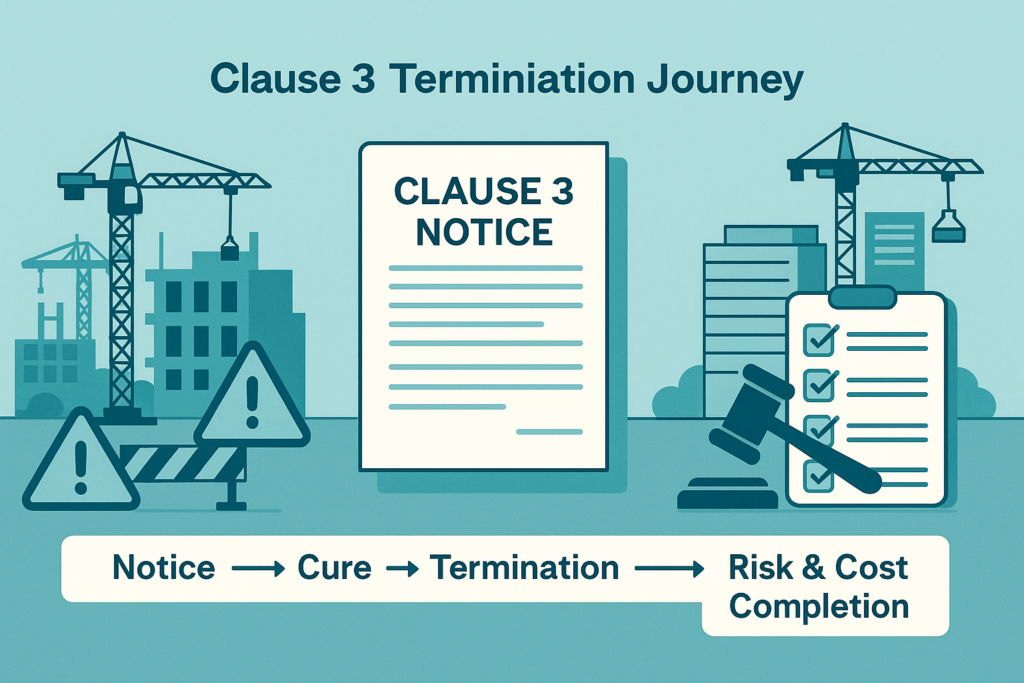
CPWD GCC · Clause 3 — Determination, Risk & Cost
6️⃣ “What if…” stories to make Clause 3 feel real 🏗️
Clause 3 looks abstract on paper. These real-world “what if” stories show how defective work, mixed delay, integrity breaches, and insolvency actually play out on CPWD jobs.
Last updated: 07 December 2025
Think of Clause 3 as a set of “triggers” plus “consequences”. These four scenarios show how those triggers work on site: from bad concrete and mixed delay, to integrity issues and full-blown insolvency. As you read, ask yourself: “If I were the Engineer or Contractor here, what paper trail would I want on record?”
Scenario 1 – Repeated bad concrete → termination under (i)
Sub-clause (i) · Defective work- Contractor keeps pouring slabs with low cube strength and honeycombing.
- EIC issues multiple instructions in the site order book, then a formal 7-day notice to demolish and recast.
- Contractor responds with promises but does not actually recast within 7 days; continues other works.
Trigger: Sub-clause (i) is engaged – failure to rectify defective work after notice. Nhidcl reference practice
What can the EIC do under Clause 3?
Here, EIC can:
• Determine the contract so far as the Contractor’s performance is concerned.
• Forfeit Performance Guarantee (PG) & Security Deposit (SD).
• Engage another contractor to complete and rectify at the first contractor’s risk & cost.
Contractor’s defence later?
If the contractor can show that the cure did happen – e.g. photos, test reports,
site records proving slabs were demolished and recast in time – the termination may be
challenged as premature.
If not, CPWD is on strong ground: the file will show bad concrete, clear
instructions, a 7-day notice, and no rectification.
Scenario 2 – Mixed delays + poor hindrance record → termination gets struck down
Sub-clause (ii)/(iii) · Lack of diligence?- Work is badly delayed – milestones are off-track.
- Site was handed over in bits and pieces, not in one go.
- Drawings were late for several blocks.
- Contractor sent multiple hindrance notices showing these issues and kept them on record.
Trigger attempted: EIC issues a Clause 3 notice under (ii)/(iii) saying “you’re not proceeding diligently” and terminates – but hindrances were never properly accounted for under Clause 5.2/5.3.
What happens in arbitration?
In arbitration:
• The contractor produces hindrance letters and evidence of delayed drawings and late site handover.
• CPWD cannot show proper EOT consideration under Clause 5.2/5.3 or reasoned orders on those hindrances.
• The record suggests the delay was at least partly on the Employer’s side.
Likely result:
The tribunal holds that Clause 3 termination was illegal and effectively
converts it into a CPWD breach. The contractor may then get:
• Prolongation costs
• Idling costs
• Loss of overheads / profit
In other words, a complete reversal of Clause 3’s intent – instead of recovering risk & cost,
CPWD may have to pay damages.
Scenario 3 – Integrity Pact violation → quick termination under (v)–(vii)
Sub-clause (v)/(vii) · Procurement fraud- Vigilance finds fake turnover certificates submitted with the bid.
- The Integrity Pact requires truthful disclosure from bidders.
- Proof is strong – letters from the bank confirm that the certificates are forged.
Trigger: EIC can invoke sub-clause (vii) (wrong tendering / non-bonafide methods / Integrity Agreement breach) and, depending on wording, possibly also sub-clause (v). Nhidcl Integrity Pact practice
What does termination really rest on?
Termination here is based on procurement fraud, not site performance. The message is clear: if the bid itself was secured by forgery or misrepresentation, CPWD does not have to continue the relationship just because the work has started.
Separate from Clause 3:
• Blacklisting / debarment proceedings may also start as per government rules.
• The contractor can face consequences across departments, not just on this one project.
Scenario 4 – Contractor goes insolvent (viii)/(ix)
Sub-clause (ix) · Insolvency / winding up- The contractor company faces multiple creditor suits; cash flow is broken.
- NCLT admits an insolvency petition and appoints a Resolution Professional.
- Work at site slows, and materials suppliers stop deliveries because they are unpaid.
Trigger: EIC can treat this as a Clause 3 (ix) event – winding up / insolvency or analogous legal process under applicable law.
What can EIC/CPWD do?
Under Clause 3, EIC can:
• Terminate the contract on insolvency grounds.
• Forfeit securities (EMD, PG, SD) to cover government exposure.
• Retender the balance work at the contractor’s risk & cost.
In such cases, arbitrators typically do not protect a contractor who is legally insolvent. The key test is whether CPWD acted reasonably and promptly once insolvency became clear – i.e. did they protect public money and ensure completion without unnecessary delay?
CPWD GCC · Clause 3 — Particular Conditions
7️⃣ Suggestions to improve clarity (if you were drafting Particular Conditions) 🛠️
If you have freedom to tweak Clause 3 in Particular Conditions, you can move it from a vague “threat” to a clear, defensible tool. Here are practical tweaks— with example wording—you can actually copy into your PCs.
Last updated: 07 December 2025
Think of these as “pre-emptive firefighting” tools. Instead of waiting for a dispute, you write your Clause 3 PCs so that everyone knows: what counts as neglect, what happens to hindrances/EOT, how Integrity Pact breaches are handled, and how risk & cost will be calculated.
1️⃣ Define “due diligence” and “persistent neglect” with numbers
Trigger clarityThe bare Clause 3 language (“not proceeding with due diligence”, “most persistent neglect”) is very subjective. In Particular Conditions, you can convert those phrases into objective thresholds.
- Use programme-based thresholds (physical and financial progress).
- Use time windows (e.g. two consecutive months).
- Combine with a requirement that hindrances must be excluded first.
“For the purposes of Clause 3(ii) and 3(iii), the Contractor shall be deemed to be failing to proceed with due diligence, or to be in persistent neglect, if (a) the achieved progress is below 80% of the approved programme for two consecutive months, (b) after excluding accepted hindrances and approved EOT, and (c) the Contractor has failed to submit and implement a credible recovery plan.”
This kind of wording still leaves room for Engineer’s judgment but gives arbitrators a clear yardstick: was progress really below 80% for two months straight, after accounting for genuine hindrances?
2️⃣ Clarify linkage with hindrance records and EOT decisions
Hindrances & EOT firstMany Clause 3 terminations get into trouble because hindrances and EOTs were never decided before invoking “lack of diligence”. PCs can make this sequence explicit.
- Require that EOT applications up to the notice date are decided first.
- Require a short, reasoned EOT order on record.
- Prevent Clause 3 action while critical hindrances are undecided.
“No action shall be taken under Clauses 3(ii) or 3(iii) unless all Extension of Time applications and recorded hindrances up to the date of notice have been decided by the Engineer-in-Charge through a reasoned order, and the revised completion period, if any, has been notified to the Contractor.”
This forces the file to show that Employer-caused delays were filtered out before blaming the Contractor’s “diligence”. It is one of the strongest protections you can build into the PCs.
3️⃣ Integrate the Integrity Pact reference explicitly under Clause 3(vii)
Integrity Pact & fraudSub-clause (vii) talks about “wrong tendering / non-bonafide methods”, but your project will usually have a specific Integrity Pact form.
- Mention the exact Integrity Pact form and its clause numbers.
- Clarify that proven breaches are grounds under Clause 3(vii).
- Keep a bridge to separate blacklisting/debarment rules.
“For the purposes of Clause 3(vii), any material breach of the Integrity Pact (Form IP-1) executed with the tender, including but not limited to misrepresentation of turnover, experience or financial capacity under Clauses 3.1 to 3.4 thereof, shall be deemed to constitute ‘non-bonafide methods of tendering’.”
That way, when Vigilance proves a forged certificate, the Clause 3 link is already written; you are not improvising a legal theory after the fraud is discovered.
4️⃣ Build in procedural fairness: show-cause + speaking decision
Due processEven in government contracts, procedural fairness matters. PCs can hard-code a simple, robust process:
- A detailed show-cause notice before termination.
- Clear identification of the sub-clause relied upon.
- A speaking order dealing with the contractor’s reply.
“Before determining the contract under Clause 3, the Engineer-in-Charge shall issue a show-cause notice stating: (a) the specific sub-clause of Clause 3 proposed to be invoked, (b) the key defaults with dates and references to site records, and (c) a summary of hindrances and EOT decisions. The Contractor shall have not less than 7 days to respond. A reasoned order shall be recorded on file dealing with the Contractor’s reply before issuing the determination notice.”
When an arbitrator later reads that speaking order, it becomes much easier to defend the decision as careful and proportionate, not arbitrary.
5️⃣ Align Clause 3 risk & cost with Clause 14 valuation mechanics
Risk & cost calculationsAfter determination, disputes usually shift to money: how much extra did it cost to get the balance work done? PCs can simply say:
- Risk & cost calculations will follow the same method as Clause 14 valuations.
- Extra cost is assessed item-wise against BOQ / DSR / justified analysis.
- Securities are adjusted against that quantified extra cost.
“Any risk-and-cost amount recoverable from the Contractor upon determination under Clause 3 shall be calculated using the valuation principles of Clause 14, as applied to the balance work at the time of determination, including use of Schedule of Quantities, DSR/market analysis and applicable price adjustment formulae.”
This reduces the scope for later arguments like “Clause 14 is only for running bills” and helps keep risk & cost recovery on familiar, measurable ground.
6️⃣ Cross-reference the CPWD Works Manual for hindrance & record-keeping
Documentation standardsIn practice, what saves you in arbitration is often not the wording of Clause 3, but the quality of the file: hindrance register, site order book, photographs, cube test results, etc.
- PCs can mandate that records be maintained as per Works Manual Chapter 5.
- They can require periodic hindrance review meetings with minutes.
- They can tie Clause 3 decisions to those standardised records.
“All hindrances, site instructions and progress reviews relevant to any action under Clause 3 shall be recorded and maintained as per CPWD Works Manual Chapter 5. The decision to invoke Clause 3 shall expressly refer to such records, which shall form part of the determination file.”
This single sentence nudges the site team to treat documentation as part of termination risk management, not just an audit formality.